Hot Tub Electrical 101: Sizing, Wiring & Breaker Upgrades
Thinking about a new hot tub? Learn how to size, wire, and upgrade your breaker box, what a spa disconnect is, and how a same-day quote and install usually works.
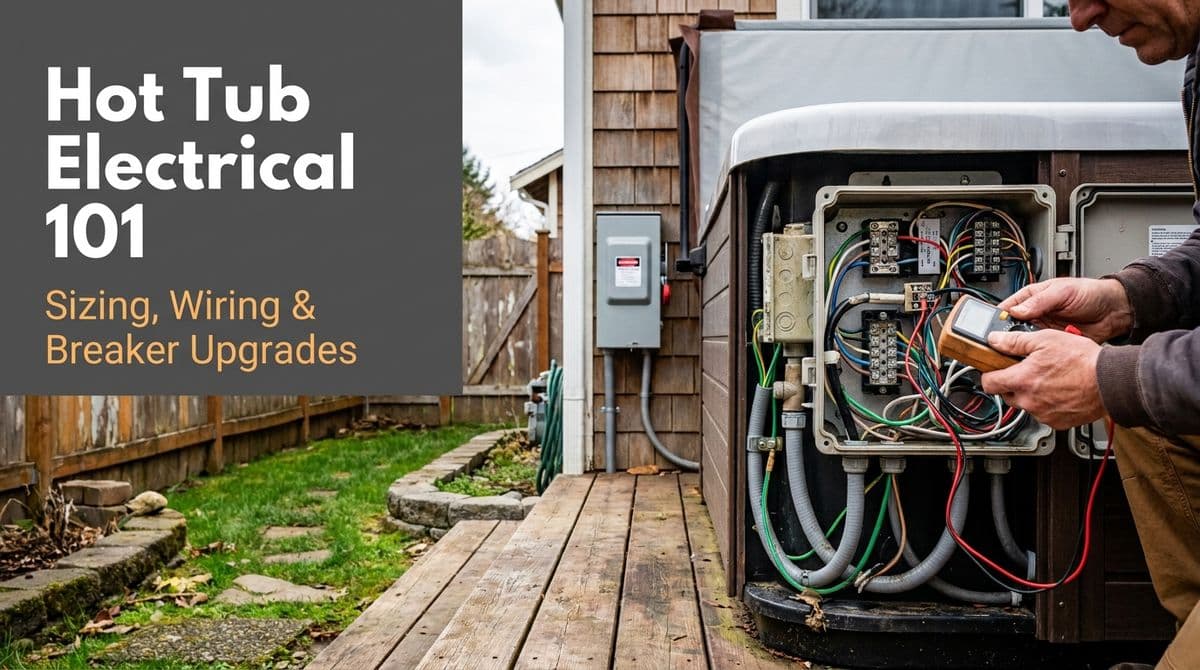
Getting Your Hot Tub Power Ready: A Real-World Example
We recently got a call from a homeowner — let's call her Lisa — who was swapping out an older hot tub for a new self-contained spa from a major brand. The sales rep had just told her, “You’ll probably need to change your breaker box,” and she understandably wanted to know what that really meant.
In Lisa’s case, she already had a standard 50–60 amp spa setup, but her new model required a split 20/30 amp configuration with a specific spa disconnect box. She also wondered when she needed us out relative to delivery, and whether we could quote and do the work the same day.
If you’re in a similar spot — new spa on order and uncertain about the electrical — this guide will walk you through how we size, wire, and, when needed, upgrade your breaker box for a hot tub.
Typical Hot Tub Electrical Requirements
Most modern, full-size spas fall into one of two common electrical setups:
1. Standard 240V, 50–60 Amp Spa Circuit
- Voltage: 240V
- Breaker size: 50A or 60A two-pole GFCI breaker
- Wiring: Typically 6/3 or 6/3 with ground copper (exact size depends on distance and manufacturer specs)
- Use case: Many traditional hot tubs and spas that run the heater and pumps on a single circuit
This is what a lot of older tubs were wired for, and what we often see when we first come out to a home.
2. Split 20/30 or 30/30 Amp Spa Circuits
Some self-contained spa systems — like many models from Hot Spring, Caldera, and similar brands — use a split circuit configuration. Instead of one big 50–60A breaker, they require two separate breakers, often:
- One 20A 240V GFCI breaker
- One 30A 240V GFCI breaker
Or in some cases, dual 30A breakers. The exact combination depends on your specific model, but the key point is: the electrical must match the spa’s wiring diagram. In Lisa’s case, her new Caldera-style system needed that 20/30 split, so her existing 50–60A setup had to be altered.
What Is a Spa Disconnect Box — and Why Do You Need It?
During our call with Lisa, the spa retailer was providing a special box for the new tub. That box wasn’t just a convenience; it was the required spa disconnect.
A spa disconnect box is a small outdoor-rated electrical panel installed near the hot tub, and it usually:
- Houses the GFCI breakers (50–60A, or split 20/30, etc.)
- Provides a local shutoff within sight of the spa, which is required by electrical code
- Acts as the transition point between your home’s main electrical panel and the spa
Many dealers for brands like Hot Spring and Caldera include the manufacturer-specified disconnect box when you purchase the spa. That’s exactly what Lisa’s salesperson did — they provided the correct box, and we came out to install it with the proper wiring.
When You Need to Change or Upgrade Your Existing Breaker
Not every new hot tub means a huge electrical overhaul, but there are common situations where we must upgrade or change things:
1. The Amperage or Configuration Has Changed
If you’re going from:
- 50–60A single breaker → to a split 20/30A setup, or
- A 110V “plug-and-play” tub → to a 240V hardwired spa
…we have to adjust the breakers and wiring to match the new tub’s requirements. That can mean:
- Installing new breakers in the main panel
- Adding or replacing the spa disconnect box
- Running new appropriately sized wire from the main panel to the disconnect and to the tub
2. Your Existing Panel Is Maxed Out or Outdated
Sometimes the issue isn’t the spa at all — it’s the house. If your main panel is already full, or if it’s an older or recalled panel, we may recommend:
- Adding a subpanel
- Upgrading the main service or panel
- Reorganizing existing circuits to free up capacity
We explain all of this on-site, with pricing, before we do any work.
Brand & Model Differences: Why Specs Matter
One thing Lisa’s call highlighted: you can’t guess from brand alone. Even within Hot Spring or Caldera, different models have different electrical requirements. Some use:
- Standard 240V 50A single-circuit setups
- Split 20/30 or 30/30 spa packs
- Unique GFCI configurations or wiring terminals
That’s why we always ask for:
- The exact spa make and model
- The manufacturer’s electrical spec sheet or wiring diagram
Once we have that, we can size the breakers and wire correctly and make sure what’s in your panel matches what’s under the spa’s control cover.
Timing: When to Schedule Electrical Work vs. Delivery
Lisa originally thought we had to come out before anything happened at all, and she was close: the ideal sequence looks like this:
- Purchase the spa. Your dealer confirms the exact electrical requirements and usually provides the spa disconnect box if it’s a branded system.
- Get the box in hand. Once you or your dealer has the disconnect box, we can schedule your electrical install.
- Schedule electrical before delivery. We aim to finish the electrical before the spa is set in place, or at least before you’re ready to fill and use it.
- Final hookup after placement. If access is tight, we may do rough-in (panel, trench, conduit) before delivery and final connections once the tub is in its final spot.
In many cases, like with Lisa, once the dealer confirms you’ve purchased the spa and released the box, we can get you on the schedule quickly.
What to Expect During a Same-Day Quote and Install
For straightforward hot tub setups, we often handle the quote and installation in a single visit, just like we planned for Lisa. Here’s how that usually goes:
1. On-Site Evaluation & Quote
- We confirm your spa model and electrical specs
- Inspect your main panel for capacity and space
- Check the distance and path from the panel to the spa location
- Look for any code issues (clearances, bonding, GFCI requirements)
Then we give you a written price right there. If you approve, we move straight into the work.
2. Installation Work
On a typical hot tub electrical install, we:
- Install the appropriate breakers in the main panel
- Mount and wire the spa disconnect box in the correct location
- Run conduit and appropriately sized wire from the panel to the disconnect and to the spa area
- Make final terminations per the manufacturer’s wiring diagram
- Test GFCI function and verify proper voltage at the spa
Most standard installs can be completed in one day, assuming access is reasonable and trenching (if needed) is straightforward.
Getting Your Spa Electrical-Ready
If you’ve just ordered a hot tub and you’re hearing terms like “20/30 split,” “GFCI spa pack,” or “disconnect box,” you’re not alone — we walk homeowners through this every week.
The simplest way to get started is to have:
- Your spa’s make, model, and electrical requirements
- Any disconnect box your dealer provided
- Your desired spa location picked out
From there, we can size the breakers, plan the wiring, let you know if your existing panel is up to the task, and, in many cases, quote and complete the work in the same visit so your new spa is ready to go as soon as it’s delivered.