Why One Side of Your Outlet or Switch Doesn’t Work
One side of your outlet or switch not working? Learn the most common causes, safety risks, and when it’s time to bring in a licensed electrician.
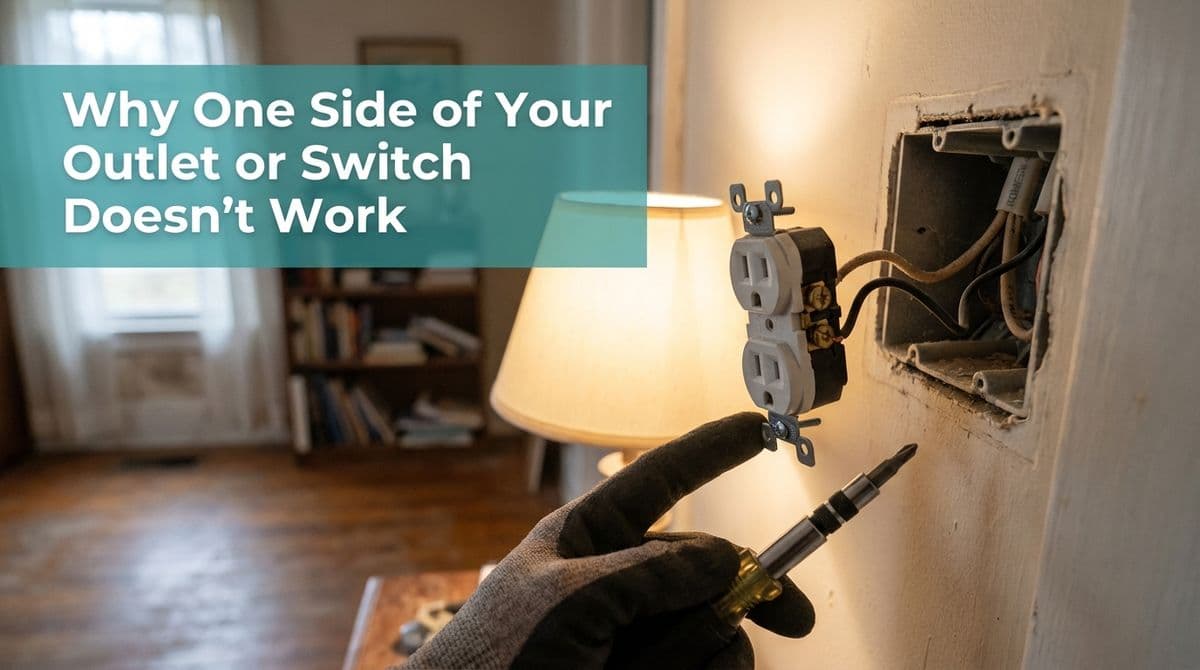
We recently got a call from a homeowner — let’s call him Marcus — who was dealing with a really common (and really frustrating) issue: two outlets in his home where one side worked and the other side didn’t. The lights would plug in and work on one half, but the other half of the outlet stayed dead. He’d already bought replacement switches and just wanted someone to come out, troubleshoot, and swap them in.
As we talked through his situation, we realized it was a perfect example of how confusing half-dead outlets and switches can be, and why the fix isn’t always as simple as “just replace the part.” So we thought we’d walk through what might be going on if one side of your outlet or switch doesn’t work, what the safety risks are, and when it’s time to call a licensed electrician.
When One Side Works and the Other Doesn’t
Marcus described what we hear a lot: “It has power, but one of the switches doesn’t work; the other does. On the other outlet it’s the same thing.” If that sounds familiar, there are a few common explanations.
In many homes, outlets and switches are wired in ways that allow part of the device to be controlled separately. Over time, that setup can become confusing, especially if the original homeowner never explained it.
Common Causes of a Half-Dead Outlet
- Switched outlets (half-hot receptacles)
Often, one half of an outlet is always live, while the other half is controlled by a wall switch. If that switch is off, appears broken, or has been removed, that half of the outlet will seem “dead,” even though nothing is technically wrong with the outlet itself. - Loose or worn connections
Back-stabbed wires (pushed into the back of the outlet instead of wrapped around the screws) can loosen over time, causing one side to lose contact. We see this a lot in older homes or heavily used outlets. - Daisy-chained wiring issues
An upstream outlet, switch, or junction box may have a loose connection. That poor connection can knock out power to just part of a downstream device. - Improper DIY changes
If a previous owner replaced a switch or outlet without understanding how the half-hot or multi-wire setup worked, they may have accidentally disconnected one side.
Why Half an Outlet Might Be “Dead” On Purpose
One thing we always ask homeowners, just like we did with Marcus, is whether a nearby switch seems to control part of the outlet. This is more intentional design than “broken outlet.”
- Living rooms and bedrooms often have switched outlets so you can control a lamp from the door instead of wiring a ceiling light.
- Half-hot outlets look completely normal from the outside, but a small metal tab is removed on the hot side, allowing each half to be controlled separately.
If someone later replaces that outlet or switch without reconnecting everything correctly, you end up in Marcus’s situation: one half works, the other doesn’t, and it’s not clear why.
When a Switch Only Works One Light or One Fan Speed
The same logic applies to switches. Homeowners will tell us, “One switch works, the other doesn’t,” when they’re actually looking at a more complex setup.
Common Switch Issues We See
- Multi-gang boxes (two or more switches together) where one switch controls a half-hot outlet and another controls a light, and one circuit has been miswired.
- 3-way and 4-way switches where one of the switches in the chain fails, making it look like “this one switch doesn’t do anything.”
- Worn-out or cheap switches that physically click but no longer make good internal contact.
Marcus had even purchased his own replacement switches, which many homeowners do to try to save money. The tricky part is that swapping a switch without understanding the wiring configuration can make things worse or less safe.
Real Safety Risks Behind a “Minor” Outlet Problem
From the outside, a half-dead outlet seems like a nuisance, not a hazard. Behind the cover plate, though, we sometimes find issues that absolutely are safety concerns.
- Loose connections that arc can generate heat, damage insulation, and in worst cases start a fire.
- Overheated or brittle wiring may indicate a long-term problem that should be corrected before it fails completely.
- Shared-neutral or multi-wire branch circuits wired incorrectly can overload a neutral conductor or defeat proper breaker protection.
- Ungrounded or improperly grounded outlets increase shock risk, especially with metal fixtures or appliances.
We never want to scare homeowners, but we also don’t want to pretend that all outlet problems are harmless. If something isn’t working the way it should, there’s usually a reason worth investigating.
What You Can Safely Check Yourself
There are a few low-risk checks most homeowners can do before calling us out:
- Test the switch: Flip any nearby switches on and off while a lamp is plugged into each half of the outlet. Label the switch if you discover it controls only one half.
- Check the breakers: Look for any tripped breakers or GFCI outlets (in bathrooms, kitchens, garages) that might have shut off part of a circuit.
- Unplug everything: If an outlet is warm or has been heavily loaded with power strips, unplug devices and let it cool. Don’t reuse it until it’s inspected.
Beyond that, once you’re taking covers off or moving wires, it’s no longer a “simple” DIY project. That’s where we recommend bringing in a licensed electrician.
When It’s Time to Call an Electrician
With Marcus, we walked through our diagnostic and pricing over the phone. He ultimately decided not to schedule, which we completely understand — sometimes the upfront cost of proper troubleshooting feels high compared to just buying a new outlet or switch.
Here’s when we strongly recommend calling a pro, even if it feels like a small issue:
- The outlet or switch is warm, buzzing, or smells burnt.
- You see scorch marks, discoloration, or melting on the device or cover plate.
- You’ve replaced the device once already and the problem came back.
- Multiple outlets or switches on the same wall or room are acting strangely.
- You’re dealing with kitchens, bathrooms, garages, or outdoors where GFCI protection is required.
When we come out, we don’t just swap parts. We trace the circuit, test connections, verify that any half-hot or multi-way setups are wired correctly, and make sure everything meets current safety standards. That way, you’re not just getting power back — you’re getting peace of mind that the problem is actually solved.
If one side of your outlet or switch isn’t working and you’re not sure why, feel free to reach out. We’re always happy to talk through what you’re seeing, give you some simple checks you can do yourself, and come out to troubleshoot it safely if needed.